
BlueAir 403 HepaSilent Air Purifier Review
Blueair air purifiers has established itself as a top-selling premium air purifier franchise, with extensive market penetration of the thin-selling class.
Blueair’s contemporary but consistent design, quality construction, engineering (instead of marketing) emphasis, and good noise/performance ratios have built a sterling reputation as a particle-focused air cleaner.
The downside with Blueairs has always been persistent replacement filter bills.
But Blueair has chopped warranty coverage to just one year, removing the user’s incentive to buy filters for warranty overage.
I get lots of emails asking me to compare cheaper air cleaners to the pricey 403 Blueairs.
It is true that some less expensive air cleaners offer more features and similar particle-only efficiency to the Blue Air 403.
Blueair is a premium brand, with sales volume sufficient for deep and broad product support. Only the costlier IQAirs can better it in this respect.
While many import models come and go, taking their service and filters with them, the conservative European premium builders make careful incremental engineering improvements to successive generations of products over decades of experience.
Blueair continues to upgrade its entire line with improved fans, motors and filter media at regular intervals, leaving the classic’s styling largely untouched until the recent advent of the Blueair Sense and Pro Series models.
This is why Blueairs are a consistent market share leader in the premium air cleaner space.
For 2010, the product line added a complete electronic interface, the Blueair e-Series.
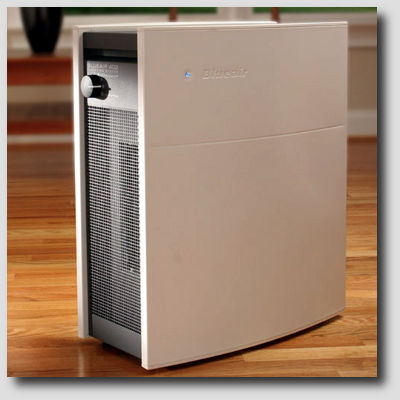
Blueair’s 403, is based on the original manually-switched Blueair air purifier – there are NO electronic sensors or automatic settings (for which see Blueair 450e).
Blueair charges around $100 for the E-series automation, I would save that money toward another air cleaner.
There is significant incorrect information on vendor websites about the 403 by Blueair, in part because it differs from other members of the product line.
While 403 is an electrostatic HEPA-type filter system, it inhales through the rear and exhales out the front, using only 1 filter.
Bigger Blueairs, 500/600 series models, have an upflow design, drawing air from beneath, and three filters.
Solid steel construction, with fan/motor outsourced to world class Ebm-Papst Ab, of Sweden (not China), says “quality.”
CADR
Blue Air 403 has four fan speed settings, NOT 3 speeds as very widely advertised on vendor websites (per Blueair customer service and owner reviews).
AHAM certified Clean Air Delivery Rates are;
240 Dust,
240 Smoke,
240 Pollen,
Room Size 370 square feet.
Blueair rates the 403 for mid-sized rooms of 365 sq. ft., for 5 air changes per hour (ACH).
To get my recommended 6 ACH, install in a maximum of 260 sq. ft., less is better.
No prefilter
While Blueair’s 3-stage filters do not require a separate prefilter, the machine can get dirty internally
Cleaning dusts accumulated inside the device is not easy – both the manufacturer and I recommend routine cleaning
Vacuum the air intake grille from the inside when you remove the filters to inspect/replace them.
“HEPASilent”
Despite the confusing trademarked name and many vendors misunderstandings, HEPASilents are different from most true-HEPAs.
Electrostatic filters. market leaders until recently (Oreck, Ionic Breeze, Friedrick, Ionic Pro…), have efficiency issues, especially as they age.
Traditional HEPA filters, while efficient even with age, have back pressure issues that create noise and use extra energy.
So Blueair’s innovative hybrid filter design uses electrostatics and charged media filters to achieve HEPA-like performance with lower energy costs and high throughput.
HEPA is a filter standard, not necessarily a pleated paper element type.
Blueair’s filter is the most successful HEPA-type filter, succeeding where many others have failed.
Incoming airborne particles are negatively charged by a brush-type ion emitter, then are attracted to the positively charged polypropylene filter media.
Three separate layers of fibers with progressively tighter spacing capture smaller particles in succession.
The Blueair 403s capture 99.97% of the 0.1 micron particles on low speed – very good efficiency.
I suspect this drops on higher speeds, and maybe with filter age, but no data is available.
This is called a “3-stage Progressive Filter.”
Confusion has arisen since Blue air added a light carbon layer to the filter for improved odor control, and used the term “2-Stage” filter. The two terms are unrelated.
402 filters did not have this carbon cloth layer.
Since polypropylene does not absorb moisture or encourage microorganism growth, no antimicrobial chemicals are added to the filter (as are often found in bargain air cleaners).
Electrostatic filters generally require very frequent user cleaning, but the HEPASilent never has to be cleaned.
It will clog in about 6 months and need replacing.
Blueair does not seal their filters as tightly as I’d like, sometimes letting a little air bypass.
This makes filter replacement a snap, but is a weakness inconsistent with the price class.
Included with the new 403 is a magnetic count-down 182 day (6 months) filter timer.
This is just a little clock which reminds users to change filters on schedule, with no relationship to actual filter condition.
Blueair recommends running the 403 24 hours a day, 7 days a week, making the timer pretty accurate.
Blueair owners buy 403 filters, for around $60, at least twice a year.
Non-pet, nonsmoking, relatively particle-free households have found they can go a year on a set.
Some report vacuuming filters periodically to extend life.
The user manual recommends vacuuming the ionizing brushes and inside the machine with every filter change.
I haven’t worked with the Blueairs yet, but when I get one, I’ll work up a low-restriction prefilter for coarse dust and try to cut into Blueair’s replacement filter sales and internal dust accumulation.
Even with the added carbon layer, the $59.95 Blueair standard HEPASilent filter has scant odor/chemical control.
SmokeStop Filters: Blueair 403SS
For buyers concerned with gas-phase pollutants and odors, Blueair offers the optional SmokeStop filter option.
I warn my readers that everybody has gas phase pollutants in their home.
But with so many folks buying air cleaners based on the incorrect perception that their purpose is collecting the visible dust that accumulates on floors and furniture, it’s understandable that Blueair made the carbon SmokeStop filter optional to hold price down.
403 Smokestop filters contain about 3 pounds of activated coconut shell carbon impregnated with added oxidizers for tough chemicals like formaldehyde.
SmokeStops have a pretty good reputation for grabbing fumes and odors, but can last even less than 180 days in tobacco smoking environments.
There is a light break-in odor from new SmokeStops, subsiding in a few days.
Blue Air 403 can also use the same 400-Series filters as the 402 and 450e.
Genuine Blueair filters are best, there are numerous inferior knockoffs and older styles on the market – watch for bait-n-switch.
Blueair 403 SmokeStop Air Purifier typically runs over $550.
Some user reviewers say the SmokeStop filters reduce airflow excessively.
Blue Air 403 Emissions
The low restriction and precision engineering make the 403 a pretty quiet 250 CADR-class air cleaner.
Some users report it is quieter than the bigger Blueairs on similar output settings, despite similar decibel readings in the 32 to 58 dB(A) range.
High speed is too loud for close use, but will clean a room pretty fast.
Speeds 1-3 are very quiet. A 403 running on speed 3 puts out 240 cubic feet per minute, plenty of capacity. This may be the most cost effective Blueair.
Blueair uses a electrical current and brush style emitters to cut ozone output, common in other electrostatics, to near zero.
Blueair’s powder coat finish and steel construction does not out-gas, though I would not select it for the chemical sensitive.
Like many purifiers, Blue air 403 has not solved the too-bright-at-night problem.
The human pineal gland, responsible for secreting melatonin, the sleep hormone, is especially sensitive to blue wavelengths, so what color are most air purifier night lights?
Users often report covering the blue LED light at night.
Utility
A bit large, at 23 inches by 20 inches by 11 inches, 403 from Blueair weighs 33 pounds and lacks casters to wheel around on.
This can be an issue where the air cleaner is carried up/down stairs or frequently moved.
The 5 foot detachable cord is too short for the price class and impedes placement.
Since the 403 moves air back to front, users often place it sideways along a wall, but the cord limits available wall locations.
Energy Star qualified at a respectable 4.45 Dust CADR per Watt, 403 uses 30 to 80 watts of power through the speeds.
Blueair Corporate
The company is headquartered in Stockholm, Sweden, with US customer service at;
Blueair Inc.
17 N. State, Suite 1830
Chicago, IL 60602
Consistent with the premium image, calls to US customer service (1.888.258.3247) are answered promptly by friendly, intelligent Americans.
A 10-year warranty was standard on Blueairs for years, but has been reduced, first to 5 years, and now to 1 with an option to extend to 5 by registration.
Many vendors still advertise the 10 year warranties.
The dropping of warranty coverage says “Don’t change filters until restriction is apparent.”
Of course, this will mean some owners with cleaner homes can go maybe two years on a filter, pet/smoker households will need frequent new filters.
Warranty is contingent on 6-month-or-better filter replacements with proof of purchase.
Despite the attempt to cut warranty claims costs, I regard Blueair as remaining among the very best in the air purifier business at supporting what they sell.
Buyers do not need to worry about filters disappearing or service becoming unavailable as may be the case with newer entrants to the premium air cleaner space.
Conclusions
Rather than being “expensive,” I regard the 403 by Blueair as the most cost effective of the Blueairs, and one of best air purifiers in the under $500 class.
I suggest the 403 as the entry-level Blueair, the lower cost Blueairs (200 series) have low CADRs and the price/performance ratio falls.
Also Blueair shoppers with under 260 square feet to clear, and who are noise sensitive, may want to consider the 403 as an alternative to the 500/600 models.

I’ve been a ceaseless campaigner against dangerous products most of my adult life.
My detailed knowledge was gained the hard way: through a 40 year struggle against multiple chemical sensitivities (MCS), chronic fatigue (CFIDS) and Fibromyalgia.
Over my incredible life I provide air purifier review knowledge to many around the world. I was reccomending HEPA filters since 2005 and was the first to use Dylos DC1100 to test air purifiers for reviews.
—————————————————————
Ed passed away in the arms of his loving wife, on December 26, 2015, at their home in Elgin, Texas.
He lives on through his contributions to the web’s air quality section. Air Purifier Power is now managed by the team at HouseFresh, which was heavily inspired by his work in air purification.